

Wind Mitigation Inspection: What Fort Lauderdale Home Sellers Need to Know Before Listing
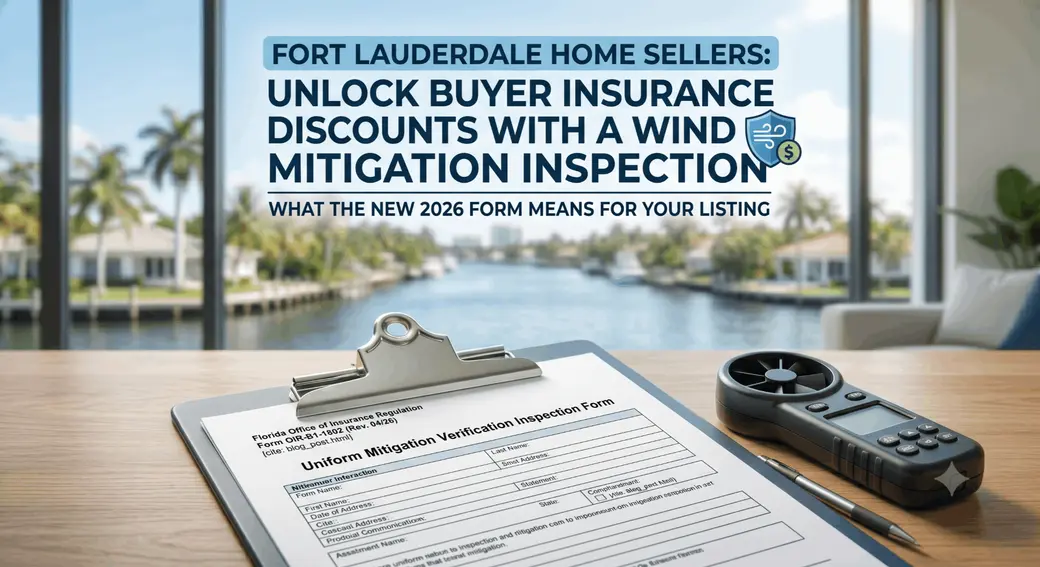
Wind Mitigation Inspection: What Fort Lauderdale Home Sellers Need to Know Before Listing
What is a wind mitigation inspection, and why does it matter when selling in Fort Lauderdale?
A wind mitigation inspection is a state-licensed assessment of your home's storm-resistance features — roof shape, deck attachment, opening protection, and more — that determines how significant a discount your buyer qualifies for on homeowners insurance. In Fort Lauderdale and Broward County, where annual premiums commonly run $4,700 to $17,000 depending on the home, a strong wind mitigation report can reduce a buyer's annual insurance cost by $800 to $1,500 per year or more. Florida law requires insurers to offer these discounts, and having the report done before listing gives buyers clear cost information they can bring to their lender. A new form — the OIR-B1-1802 — took effect April 1, 2026, with stricter documentation requirements, which means older reports may no longer reflect the full picture.
By Scott Morreau | May 21, 2026
Here's something experienced South Florida agents know: buyers in Broward County ask about insurance before they ask about anything else.
Not the kitchen. Not the bathrooms. Insurance.
It makes sense. Homeowners insurance in Fort Lauderdale can run anywhere from $4,700 to $17,000 per year depending on the home, the roof age, the construction type, and the protection features. For a buyer financing a $900,000 home, that insurance cost either makes the monthly payment work — or it doesn't. And when a private insurer won't quote the property, the deal can fall apart before it even gets to the inspection phase.
That's where your wind mitigation report comes in.
A wind mitigation report isn't about proving your home is in good condition — that's what a 4-point inspection covers. The wind mitigation is specifically about what discounts your buyer qualifies for on their homeowners insurance, based on your home's storm-resistance features. In a market where insurance costs have become one of the top reasons buyers walk away, handing your buyer a report that shows them they'll save $1,000 a year on insurance is a competitive advantage most sellers don't bother to create.
And right now, there's a new reason to get current: Florida's updated wind mitigation form took effect on April 1, 2026, with stricter documentation requirements than the 2012 version it replaced.
Why Insurance Costs Have Changed the Selling Game in Broward County
Fort Lauderdale sits in a High Velocity Hurricane Zone. That single classification means every home in Broward County faces stricter building codes, higher insurance premiums, and tighter underwriting criteria than most of the country.
The numbers reflect this. The average homeowners insurance premium in Fort Lauderdale is now $4,717 per year for a home with $300,000 in dwelling coverage — but for larger homes with older construction or coastal exposure, that number climbs fast. Properties in Victoria Park, Coral Ridge, and Harbor Beach commonly run $10,000–$17,000 or more annually before flood coverage is added.
For buyers, that insurance cost gets factored into their debt-to-income ratio by their lender. A policy that comes in $3,000 higher than expected can push a buyer outside their qualification limit. This isn't a theoretical concern — it's a real reason deals die after a buyer gets their insurance quotes.
A wind mitigation report changes this dynamic by documenting exactly which of your home's features qualify for discounts. Florida law (under Florida Statute 627.0629) requires all property insurers to file actuarially sound discounts for wind-resistant construction features. If your home has those features, the savings are real and guaranteed by law — your buyer just needs the report to unlock them.
What a Wind Mitigation Inspection Actually Examines (and the New 2026 Form)
The inspection is conducted by a licensed home inspector, a licensed roofing contractor, a general contractor, or a structural engineer. It takes about 45–90 minutes for a typical single-family home. The inspector needs access to the interior, the attic, and the exterior perimeter.
The current OIR-B1-1802 form — which took effect April 1, 2026 — evaluates these primary features:
Roof covering. The type of roofing material and when it was installed. A newer, permitted roof covering with documentation earns better scores.
Roof deck attachment. How the roof decking is fastened to the rafters or trusses. Homes built or reroofed after the stricter post-2002 Florida Building Code requirements typically have 8d nails on a 6-inch pattern, which earns the highest credit.
Roof-to-wall connection. How the roof framing connects to the walls. Hurricane clips and straps perform better than toenailed connections. This is the most significant single factor — and requires attic access to verify.
Roof shape. Hip roofs (sloped on all four sides) outperform gable roofs in wind events and earn significantly higher credits. Field testing shows hip roofs receive up to 40% less wind pressure than gable roofs.
Opening protection. Every window, door, skylight, and garage door on the home. The entire home must qualify — if one door or opening doesn't meet impact standards, the entire home scores as unprotected. Impact-rated windows and doors, accordion shutters, and panel systems all qualify depending on their rating.
Secondary water resistance. Whether a self-adhering barrier was installed on the roof deck beneath the shingles to prevent water intrusion if the roof covering fails in a storm.
New in 2026: Region (design wind speed) and Roof Slope. Two new data fields were added to the updated form, along with a stricter documentation requirement — at least one photograph or supporting document must accompany the form to validate each attribute marked.
This last point matters if you have an older wind mitigation report. Under the 2012 form, inspectors had more latitude in how they documented results. The 2026 form closes that latitude. The same house could come back with a different result under the new form — not because anything changed about the property, but because the documentation standard increased.
The seller takeaway: If your existing wind mitigation report is more than 1–2 years old, or was done before April 1, 2026, it's worth getting a current report before you list. Reports typically cost $75–$150 and are valid for five years — but only if the insurance carrier will accept the old form, which is no longer guaranteed once July 2026 arrives.
What Features Save Your Buyer the Most Money
The discount potential varies by feature, but here's what the most impactful attributes typically deliver:
- Hip roof: 5–15% discount on the windstorm portion of the premium.
- Impact-rated opening protection (all openings): 15–35%+ discount, depending on the rating and coverage.
- Hurricane clips or straps (roof-to-wall connection): One of the highest-value credits, particularly for homes built before 2002 that have been retrofit.
- Secondary water resistance: Additional savings, usually 5–10%.
- Combination of all features: Combined discounts can reach 20–50% off the windstorm premium.
For a Fort Lauderdale buyer paying $8,000 per year in insurance, a 25% windstorm discount translates to $2,000 per year — $166 per month. That can shift a financing calculation in a meaningful way.
For sellers with impact windows, a hip roof, and a well-documented post-2002 roof system, the wind mitigation report becomes a marketing document. You're not just describing your home — you're proving it'll cost less to insure than the comparable down the street.
This is exactly the kind of information I walk through with every seller before we finalize a listing strategy. The homes that get the cleanest offers in today's Broward County market are the ones where buyers come in with their insurance picture already solved.
Should You Get One Before Listing?
In most cases, yes — especially if your home has impact windows, a hip roof, or hurricane straps/clips. Here's the logic:
If your home scores well, the report reduces the buyer's insurance cost, which can improve their lender qualification and create cleaner offers. You can proactively share the report in your listing materials, which reduces the "insurance fear" that causes buyers to hesitate or renegotiate after inspection.
If your home doesn't score as well as you'd hoped, you know before you go to market — and you can make informed decisions about whether to make targeted improvements or price and market the home accordingly. A new impact-rated garage door, for example, runs $2,000–$5,000 and can meaningfully improve a home's opening protection score.
Either outcome is better than discovering the insurance issue mid-transaction.
One more consideration for sellers with older wind mitigation reports: the April 1, 2026 form change means insurance carriers will start expecting the new OIR-B1-1802 format for any new inspections, with July 2026 as the deadline for credit eligibility. If your buyer's lender or insurer asks for an updated report after you're under contract, you'll be managing that timeline during escrow. Getting it done before listing removes that variable entirely.
For sellers in this market — where 44.9% of Fort Lauderdale sellers cut their list price and homes average 100+ days on market — every pre-listing step that builds buyer confidence and reduces re-negotiation risk is worth taking seriously. Understanding what you'll net at closing starts with understanding everything that can affect your buyer's ability to qualify and close.
Frequently Asked Questions
How much does a wind mitigation inspection cost in Fort Lauderdale?
Most wind mitigation inspections in Fort Lauderdale range from $75 to $150 for a standard single-family home. Some inspectors bundle them with a 4-point inspection for $150–$225 total. The inspection is almost always paid for in the first year of insurance savings if your home qualifies for significant credits.
How is a wind mitigation inspection different from a 4-point inspection?
The 4-point inspection covers the four core systems — roof, HVAC, plumbing, and electrical — and is used by insurers to determine whether a home is insurable at all. The wind mitigation inspection is specifically about storm-resistance features and is used to calculate how much of a discount the homeowner qualifies for on their windstorm premium. Many inspection companies offer both in the same appointment. You can learn more in Florida's 4-Point Inspection: What Fort Lauderdale Home Sellers Need to Know.
Do I need a new inspection for the 2026 form?
If your existing wind mitigation report was done before April 1, 2026, it may still be valid short-term. Insurance carriers are expected to begin requiring the new OIR-B1-1802 form for credits starting in July 2026. If your report is within its 5-year window but uses the old form, it may be accepted briefly — but a new report gives buyers and their insurers certainty. For $75–$150, that certainty is usually worth it before listing.
How long is a Florida wind mitigation report valid?
Wind mitigation reports are typically valid for five years in Florida, as long as nothing material about the home's structure has changed. If you replace your roof, add or remove opening protection, or make structural changes, a new inspection is required to reflect the updated features.
Can a wind mitigation report help me sell my home faster?
In Broward County's current market — where insurance costs are a leading cause of buyer hesitation and deal fallouts — yes. A completed wind mitigation report gives buyers and their lenders documented proof of the home's insurance discount potential before they write an offer. It reduces the number of unknowns, which tends to reduce re-negotiations after inspection. Sellers who provide this report upfront signal preparedness, which buyers in a buyer's market notice.
A wind mitigation report is one of the lowest-cost, highest-impact pre-listing steps available to Fort Lauderdale sellers. At $75–$150, it costs less than a professional cleaning and can meaningfully affect your buyer's ability to qualify for financing, the confidence they bring to the offer, and the likelihood your deal closes without renegotiation.
If you're thinking about listing in Fort Lauderdale, Wilton Manors, Coral Ridge, Victoria Park, or anywhere in Broward County, I'm happy to walk you through exactly what to expect — the insurance picture, your market positioning, and the pre-listing priorities specific to your home. Reach out at scottsellsfl.com.
About Scott Morreau
Scott Morreau, PA is a top-rated Realtor® and Broker Associate with Real Broker, LLC, specializing in residential real estate across Fort Lauderdale, Wilton Manors, Oakland Park, Pompano Beach, Dania Beach, and Broward County. Licensed since 2001 and active in South Florida since 2006, Scott has closed over $52 million in Florida real estate — including $7.1 million in the past year — and is ranked among the top 500 agents in the region with 70+ five-star reviews. Scott specializes in luxury and waterfront homes, investment properties and 1031 exchanges, relocation to and from South Florida, and serving LGBTQ+ clients, and is known for his concierge-level preparation and client-first philosophy he calls A Better Real Estate Experience.
Categories
- All Blogs (182)
- 01. Local News & Lifestyle (5)
- 02. Market Updates (21)
- 03. Home Prices & Inventory (10)
- 04. Mortgage & Interest Rates (11)
- 05. Affordability & Rent vs. Buy (8)
- 06. Buyer Tips, Myths & Guides (35)
- 07. Selling Tips, Myths & Guides (44)
- 08. Demographic Trends (11)
- 09. New Construction (7)
- 10. Real Estate News & Insights (14)
- 11. Featured Listings (1)
- 12. Community Spotlights (1)
- 13. Legal & Policy Updates (8)
Recent Posts


"My job is to find and attract mastery-based agents to the office, protect the culture, and make sure everyone is happy! "