

What does it cost to sell a house in Fort Lauderdale, FL?

What does it cost to sell a house in Fort Lauderdale, FL?
Selling a home in Fort Lauderdale, FL involves several cost categories that reduce what you actually pocket at closing: Documentary Stamp Tax on the deed (a Florida statutory charge), brokerage commission (fully negotiable), title company fees, property tax prorations, and — for condos or HOA communities — estoppel and transfer fees. The exact dollar amounts are deal-specific, but understanding each category upfront lets you walk into a listing appointment with realistic expectations and real negotiating clarity.
Every Cost Category on a Fort Lauderdale Seller Net-Sheet
Here's what I tell every seller who sits down with me before we list: your net proceeds aren't just the sale price minus your mortgage. There are a dozen line items between those two numbers, and some of them will surprise you if you haven't sold in Greater Fort Lauderdale recently.
The good news is that most of these costs are either fixed by Florida statute or calculated from your contract price — so once we have an offer in hand, I can model your net-sheet precisely. Let me walk you through each category.
Documentary Stamp Tax on the Deed
Florida imposes a Documentary Stamp Tax on deeds at a statutory rate of $0.70 per $100 of consideration for all counties except Miami-Dade, according to the Florida Department of Revenue. Broward County — which covers all of Greater Fort Lauderdale — uses this standard rate. The tax is triggered when the deed is recorded with the Broward County Clerk of Courts and is calculated on the full contract price.
Who pays it? That's where sellers often get a surprise. Local custom in South Florida treats the deed doc stamp as a seller cost, but there is no law requiring that allocation. The parties are free to negotiate it either way in the purchase contract. I've seen buyers absorb it in competitive multiple-offer situations, and I've seen sellers credit it back in slower markets. The point is: it's a negotiable item, not a statutory seller obligation.
Because it's calculated directly from the contract price, this is one of the few closing-cost line items I can compute precisely the moment we have a signed offer — which is exactly why I build it into every net-sheet I run for my clients.
Brokerage Commission
Commission is fully negotiable and not set by law, the MLS, or any regulatory body. There is no standard, typical, or customary rate — period. As the National Association of REALTORS® and Florida Realtors both emphasize, the commission you pay is agreed to in writing in your listing agreement, and it is specific to your transaction.
Two things worth understanding post-2024: the listing-side fee and any compensation a seller chooses to offer a buyer's agent are separate, independently negotiable items. Sellers are not automatically required to pay the buyer's agent's compensation — that's a contract decision. I cover this in more detail in my post on whether Fort Lauderdale sellers have to pay the buyer's agent commission.
What I will tell you: commission is typically the largest single line item on your net-sheet. Agree to it with full clarity before you sign a listing agreement — not after.
Title Company Fees
In Broward County, most residential closings run through a title company or real estate law firm acting as the settlement agent. Their role is substantial: they run the title search through Broward County Official Records, prepare the Closing Disclosure, collect and disburse all funds, pay off your existing mortgage, and issue both the owner's and lender's title insurance policies.
Florida title insurance premiums are set by the state — the base rate is promulgated by the Florida Office of Insurance Regulation, not individually by each title company. What does vary by provider are the ancillary charges: settlement/closing fee, title search and exam fee, courier and wire fees, and document-prep charges. These all appear as separate line items on your closing statement.
Who pays the owner's title policy? In many South Florida transactions using the standard FAR/BAR contract forms, local custom points toward the buyer paying for the owner's policy when the buyer selects the title company — but this is clearly marked as negotiable in the contract and frequently adjusted in competitive offers. Your net-sheet will reflect whichever allocation your contract specifies.
Recording Fees and Mortgage Payoff
When your sale closes, your existing mortgage gets paid off and released. The Broward County Clerk of Courts charges recording fees to record that release, and those appear on the seller's side of the closing statement. If you have a second mortgage, HELOC, or any recorded lien, each one generates its own payoff and recording fee.
Your mortgage payoff isn't just the principal balance — it includes per-diem interest calculated through the closing date, plus any prepayment penalty if your loan has one (less common today, but worth confirming with your lender). I always make sure my clients request a formal payoff statement from their lender early in the process so there are no surprises on the closing statement.
Property Tax Proration
Broward County property taxes are assessed on a calendar-year basis and typically become payable in November, according to the Broward County Tax Collector. When you sell mid-year, you owe your share of that year's taxes up to the closing date — even if the bill hasn't been issued yet.
If the closing happens before the new tax bill arrives (which is common in Greater Fort Lauderdale), the net-sheet uses the prior year's tax bill as an estimate, sometimes adjusted for known changes in assessed value. The Broward County Property Appraiser publishes assessed values that help inform this calculation. The proration shows up as either a credit or debit to the seller depending on the closing date and whether taxes have already been paid for the year.
HOA and Condo Estoppel Fees
If your home is in an HOA or condo association — and a large share of Greater Fort Lauderdale properties are — expect an estoppel letter fee on your closing statement. The association or its management company charges this fee to produce a letter confirming your dues balance, any arrears, and any pending or approved special assessments. That letter is required before the title company can close the transaction.
Beyond the estoppel fee, many Broward associations also charge a transfer or application fee when ownership changes hands. Local practice varies on whether the buyer or seller pays these, and it's often specified in the HOA documents or negotiated in the contract. If there's a pending special assessment, your net-sheet needs to show whether you're paying it off at closing or whether the buyer is assuming it — that's a negotiating point I walk my clients through on every condo or HOA transaction.
Seller Concessions and Repair Credits
Concessions are entirely negotiated, but they directly reduce your net. In Greater Fort Lauderdale's current market, common patterns include a general closing-cost credit (a flat dollar amount credited to the buyer at closing), a repair-specific credit instead of completing a repair before closing, or an HOA assessment credit for a known upcoming assessment.
Every dollar of concession is a dollar off your net. I model multiple concession scenarios in every net-sheet I prepare — so you can see exactly what you'd walk away with if you give $X versus $Y, rather than guessing in the middle of a negotiation.
The Disclosures That Are Part of Every Fort Lauderdale Sale
Costs aren't the only thing that can blindside a seller. Two disclosure obligations are baked into every Greater Fort Lauderdale residential transaction, and getting them wrong can create post-closing liability that costs far more than any closing fee.
Seller's Property Disclosure
Florida doesn't have a single statutory disclosure form, but Florida case law imposes a clear duty on sellers to disclose known latent material defects that a buyer couldn't reasonably discover on their own. In practice, Fort Lauderdale sellers complete a Florida Realtors Seller's Property Disclosure form covering roof age and leaks, HVAC and plumbing systems, termite/WDO history, past insurance claims, permits for improvements, HOA governance issues, and environmental concerns like mold.
In Greater Fort Lauderdale, the completed disclosure is typically uploaded to the MLS so buyers can review it before writing offers. If you discover a new defect — a fresh roof leak, for example — after delivering the initial disclosure but before closing, the right move is to update the disclosure immediately and notify the buyer. Staying silent on a known issue creates post-closing fraud exposure that no seller wants.
Florida Flood Disclosure (Required Since October 1, 2024)
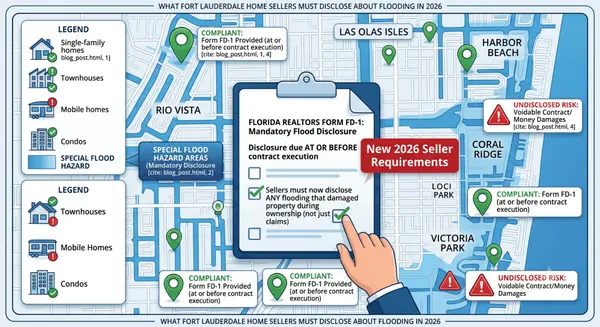
As of October 1, 2024, Florida law requires a Seller Flood Disclosure before or at contract signing on all residential sales. The disclosure must state whether the property is in a designated flood zone, explain that standard homeowners insurance doesn't cover flood damage, and advise the buyer to investigate flood insurance.
This matters especially in Fort Lauderdale, where canal-front neighborhoods, Intracoastal-adjacent properties, and low-lying inland areas mean FEMA Special Flood Hazard Areas are widespread. I cover this in depth in my post on the Florida Flood Disclosure and what Fort Lauderdale sellers need to know. Listing agents and title companies commonly consult the FEMA Flood Map Service Center to confirm flood zone status before completing the form.
What a Fort Lauderdale Net-Sheet Actually Looks Like
Here's the structure I use when I sit down with a seller to model their proceeds. The math starts with the contract price and works down:
| Net-Sheet Line Item | How It's Determined | Negotiable? |
|---|---|---|
| Contract price | Agreed between buyer and seller | Yes |
| Existing mortgage payoff | Lender payoff statement (principal + per-diem interest) | No |
| Brokerage commission | Listing agreement (fully negotiable) | Yes |
| Documentary Stamp Tax on deed | $0.70 per $100 of sale price (FL statutory rate, Broward County) | Allocation negotiable |
| Owner's title insurance premium | State-promulgated rate (FL OIR); allocation by contract | Allocation negotiable |
| Title company settlement/closing fee | Varies by provider | Allocation negotiable |
| Recording fees (mortgage release) | Broward County Clerk of Courts fee schedule | No (fixed by county) |
| Property tax proration | Prior year's bill or current assessed value, prorated to closing date | Method negotiable |
| HOA/condo estoppel fee | Association or management company charge | Allocation negotiable |
| HOA/condo transfer fee | Set by association documents | Allocation negotiable |
| Outstanding assessments or liens | Must be paid off at closing | No |
| Seller concessions / repair credits | Negotiated in contract or post-inspection | Yes |
| Estimated net proceeds | What you walk away with | — |
Notice that most line items have "negotiable" in the third column. That's not a loophole — it's leverage you have in every transaction, and it's exactly why I update the net-sheet multiple times as offers, inspection results, and concession requests evolve. Your net isn't fixed until you sign the closing statement.
One more thing worth flagging: if your sale triggers a capital gains tax liability — which can happen if the property isn't your primary residence or you've owned it for less than two years — that's a separate calculation entirely. I cover it in detail in my post on capital gains tax when selling your Fort Lauderdale home. Talk to your tax advisor before you close.
Frequently Asked Questions
Who pays the Documentary Stamp Tax when selling a house in Fort Lauderdale — and can it be negotiated?
The Documentary Stamp Tax on the deed is set by Florida statute at $0.70 per $100 of the sale price for Broward County, according to the Florida Department of Revenue. Local custom in South Florida often treats it as a seller cost, but there is no law requiring that allocation — the purchase contract can assign it to the buyer, split it, or leave it as-is. In competitive offer situations, I've seen buyers absorb it entirely. Always confirm the allocation in your signed contract.
How are property taxes prorated at closing in Fort Lauderdale if the new tax bill hasn't been issued yet?
Broward County taxes are assessed on a calendar-year basis and typically become payable in November, per the Broward County Tax Collector. If you close before the new bill arrives — which is common — the title company uses the prior year's tax bill as an estimate, sometimes adjusted for known changes in assessed value from the Broward County Property Appraiser. The proration credits or debits you for your share of the year up to the closing date, and it's reconciled when the actual bill is issued.
What does the Florida Flood Disclosure law mean for me if I'm selling near the water or canals in Fort Lauderdale?
Since October 1, 2024, Florida requires all residential sellers to provide a Seller Flood Disclosure before or at contract signing — stating whether the property is in a flood zone, noting that standard homeowners insurance doesn't cover flood damage, and advising the buyer to investigate flood insurance. In Fort Lauderdale, where canal-front and Intracoastal-adjacent properties are common, this disclosure is especially important because many homes fall within FEMA Special Flood Hazard Areas. Listing agents typically confirm flood zone status using the FEMA Flood Map Service Center before completing the form.
Are HOA and condo estoppel fees my responsibility as the seller, or can I negotiate those with the buyer?
Estoppel and transfer fees are not legally mandated to fall on any one party — they're negotiable in the purchase contract, and local practice in Greater Fort Lauderdale varies by community and transaction. The estoppel fee is charged by the association or management company to produce a letter confirming dues, arrears, and any pending special assessments; it's a required step before closing. Whether the seller or buyer absorbs it is a contract decision, and I always make sure my clients know their options before we agree to terms.
How do seller concessions and repair credits affect my net proceeds in Greater Fort Lauderdale?
Every dollar of concession you offer — whether it's a general closing-cost credit, a repair credit after inspection, or an HOA assessment credit — comes directly off your net proceeds at closing. Concessions are strictly negotiated and often tied to inspection findings or appraisal results. When I prepare a net-sheet for my clients, I model multiple concession scenarios so you can see the real impact of offering $X versus $Y before you respond to a buyer's request — not after you've already agreed to it.
Your net proceeds depend on your contract price, your mortgage balance, which costs your contract assigns to you, and what concessions you agree to. Online estimates won't capture any of that — a deal-specific net-sheet will.
I handle every transaction personally, and I build a detailed net-sheet for every seller I work with before we even talk about a list price. If you're thinking about selling in Fort Lauderdale, Wilton Manors, Oakland Park, Pompano Beach, or anywhere in Greater Broward, let's run your numbers together. Schedule a consultation and I'll show you exactly what you can expect to walk away with.
Equal Housing Opportunity. Scott Morreau, P.A. is a Broker Associate with Real Broker, LLC (Licensed since 2001), regulated by the Florida Real Estate Commission. Real Broker, LLC main office: 8291 Championsgate Blvd., Championsgate, FL 33896. Meetings at 2312 Wilton Drive are by appointment only; that location is not a registered branch office and is not open to the public. This article is general information only — not legal, tax, or financial advice. Confirm your own closing costs, tax obligations, and net proceeds with your attorney, tax advisor, lender, or escrow/closing officer.
Categories
- All Blogs (170)
- 01. Local News & Lifestyle (5)
- 02. Market Updates (21)
- 03. Home Prices & Inventory (10)
- 04. Mortgage & Interest Rates (11)
- 05. Affordability & Rent vs. Buy (8)
- 06. Buyer Tips, Myths & Guides (35)
- 07. Selling Tips, Myths & Guides (44)
- 08. Demographic Trends (11)
- 09. New Construction (7)
- 10. Real Estate News & Insights (14)
- 11. Featured Listings (1)
- 12. Community Spotlights (1)
- 13. Legal & Policy Updates (8)
Recent Posts




"My job is to find and attract mastery-based agents to the office, protect the culture, and make sure everyone is happy! "