

Florida’s New 2025 Flood Disclosure Rules for Homes & Rentals

What Florida’s New Flood-Disclosure Rules Mean for Buyers, Sellers, & Landlords (Effective October 1, 2025)
You’ve likely heard about the new flood-disclosure rules in Florida that kicked in October 1, 2025 — but what do they really mean for you if you’re buying, selling, or renting here in the greater Fort Lauderdale area (or anywhere else in Florida)? Let’s break it down simply and clearly.
TL;DR — Why this matters
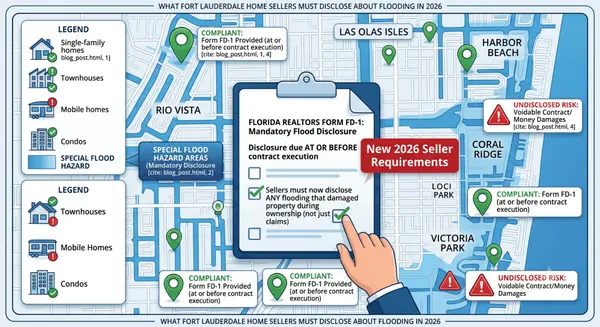
As of October 1, 2025, anyone selling or leasing residential property (homes, condos, rentals, mobile-home parks) must give a written flood-history disclosure. That means past floods, insurance claims, or FEMA/state aid must be reported — even if no claim was filed. If they don’t, buyers or tenants may have legal grounds to back out or terminate. For buyers or renters, it’s more transparency (and fewer nasty surprises). For sellers or landlords, it’s a compliance must-have.
What changed — Who needs to disclose flood history now?
Sellers of residential properties — Under Florida Statute § 689.302, when you sell your home you must complete a formal Flood Disclosure. That includes whether you know the home has ever flooded during your ownership, whether you filed a flood insurance claim, or received flood-related assistance (FEMA or otherwise). Online Sunshine +2 Gould Cooksey Fennell +2 Landlords and rental property owners — Under newly created Florida Statute § 83.512, if you lease a residential property for one year or longer (starting October 1), you must provide a standalone flood disclosure before the lease is signed — not buried somewhere in the fine print of the lease. Florida Senate +2 Florida Senate +2 Condo/co-op developers & mobile-home park owners — If you’re selling or leasing a condo, or leasing a mobile-home lot, the law applies too. Disclosure must include flood history for the unit and common areas or site in the case of condos. Florida Senate +2 Gould Cooksey Fennell +2
What the disclosures must include
The flood disclosure forms must clearly state: Whether the property has ever experienced flooding during the current owner’s ownership. Online Sunshine +1 Whether a flood-related insurance claim was filed. henlaw.com +1 Whether the owner received any disaster assistance (FEMA or other flood-damage aid). flhouse.gov +1 A standard reminder: homeowners’ or renters’ insurance does not cover flood damage — so buyers/renters should consider separate flood insurance. Online Sunshine +1 Additionally, the law defines “flooding” broadly — that includes overflow of tidal or inland waters, heavy runoff or drainage-ditch overflow, or standing water from sustained rainfall. Florida Senate +1
Consequences if disclosure is omitted or false
For sellers: failure to provide the required disclosure might lead to a voidable purchase contract, potential misrepresentation claims, or professional liability. Florida Senate +1 For landlords/tenants: If a required flood disclosure isn’t provided — or if the landlord misstates flood history — and the tenant incurs a “substantial loss” (e.g., damage to personal property after flooding), the tenant may terminate the lease. They must provide written notice and can get a refund of prepaid rent for the unused period. Florida Senate +2 martinezlawfla.com +2 Importantly — the requirement is for leases signed on or after October 1, 2025. Existing leases typically don’t require retroactive disclosures unless the lease is renewed or re-signed. amgrents.com +1
What this means for Fort Lauderdale area buyers, sellers & renters
If you’re in Fort Lauderdale, Wilton Manors, Oakland Park, Pompano Beach, Dania Beach or surrounding communities: Buyers now get a clearer picture of a home’s flood history — that matters big time along our coastlines, low-lying areas, or older neighborhoods. Sellers — expect more questions upfront. You should gather flood history records, insurance claims, FEMA or state aid documentation before listing. Landlords & rental-property owners — need to update lease forms and make sure new tenants get the stand-alone flood disclosure. Overlooking this could lead to headaches down the road. Renters — this gives you more information and peace of mind. If flood history is disclosed, you can factor flood insurance or mitigation into your decision. If it’s not disclosed and problems arise, you may have recourse.
What you (or I, as your agent) should do next — checklist
Use the new statutory Flood Disclosure form (or your brokerage’s updated version) for any home sale, lease, or condo sale. Ask for property history: prior flooding, insurance claims, repairs, any FEMA or state aid. For buyers/renters: review disclosure carefully, check flood-zone maps (FEMA), consider separate flood insurance, maybe request elevation certificates or inspection reports. For sellers/landlords/developers: keep full documentation and signed disclosure forms — traceability is key.
This law reflects growing demand for transparency, especially in a state where storms, rising seas, and heavy rains are an ever-present reality. As your local real estate resource, I’ll help you navigate these rules, avoid surprises, and make informed decisions whether you’re buying, selling or renting.
TL;DR Summary
- Effective October 1, 2025, flood-history disclosure is required for home sales, leases, condo sales, and mobile-home lots in Florida. :contentReference[oaicite:13]{index=13}
- Sellers, landlords, and developers must disclose any known flooding, flood insurance claims, or aid received during ownership — even if no insurance claim was filed. :contentReference[oaicite:14]{index=14}
- For rentals with terms of one year or more, landlords must provide a separate “Flood Disclosure” document before lease signing. :contentReference[oaicite:15]{index=15}
- If required disclosure is missing or false and flooding causes substantial loss, buyers or tenants may rescind deals or terminate leases. :contentReference[oaicite:16]{index=16}
- For you — this means extra due diligence when buying, selling, or renting in Fort Lauderdale area properties. Flood history now matters more than ever.
About Scott Morreau
Scott Morreau, PA is a top-rated Realtor® and Broker Associate with Real Broker, LLC, specializing in residential real estate in Fort Lauderdale, Wilton Manors, Oakland Park, Pompano Beach, Dania Beach, and the surrounding area. Licensed since 2001 and active in South Florida since 2006, Scott has closed over $52 million in Florida real estate, with $7.1 million in the past year alone. Scott is ranked among the top 500 agents in the region with 70+ five-star reviews. He is a trusted resource for luxury and waterfront homes, investment deals (including 1031 exchanges), relocation services, and clients across many backgrounds including LGBTQ+ buyers. Known for concierge-level preparation, expert market insight, and a client-first approach he calls A Better Real Estate Experience.
📲 Call or text Scott at (954) 562-5111 or visit Scott Morreau PA – Top Realtor Wilton Manors & Fort Lauderdale Real Estate
Disclaimer
This blog post is provided for informational purposes only and should not be construed as a guarantee regarding property values, market conditions, or transaction outcomes. Market data reflects the specific time periods examined, and conditions change continuously. Real estate decisions should be based on individual circumstances, professional guidance, and current market conditions at the time of the transaction. Past market performance does not predict future results. Readers should conduct independent research and consult with qualified professionals before making real estate decisions. Scott Morreau, P.A., REALTOR®, and Real Broker, LLC, make no warranties regarding the accuracy, completeness, or applicability of information to specific circumstances.
Categories
- All Blogs (170)
- 01. Local News & Lifestyle (5)
- 02. Market Updates (21)
- 03. Home Prices & Inventory (10)
- 04. Mortgage & Interest Rates (11)
- 05. Affordability & Rent vs. Buy (8)
- 06. Buyer Tips, Myths & Guides (35)
- 07. Selling Tips, Myths & Guides (44)
- 08. Demographic Trends (11)
- 09. New Construction (7)
- 10. Real Estate News & Insights (14)
- 11. Featured Listings (1)
- 12. Community Spotlights (1)
- 13. Legal & Policy Updates (8)
Recent Posts




"My job is to find and attract mastery-based agents to the office, protect the culture, and make sure everyone is happy! "